
MRI scan
An MRI scan provides detailed images of the body’s tissues and can be used to examine the brain, spine, joints, muscles and tendons, among other things.
The examination uses a powerful magnetic field and radio waves. Therefore, X-rays are not used in an MRI scan.
At CPH Privathospital you are examined by experienced radiographers and consultant radiologists. We ensure that we inform and guide you through the entire examination, so you know what will happen.
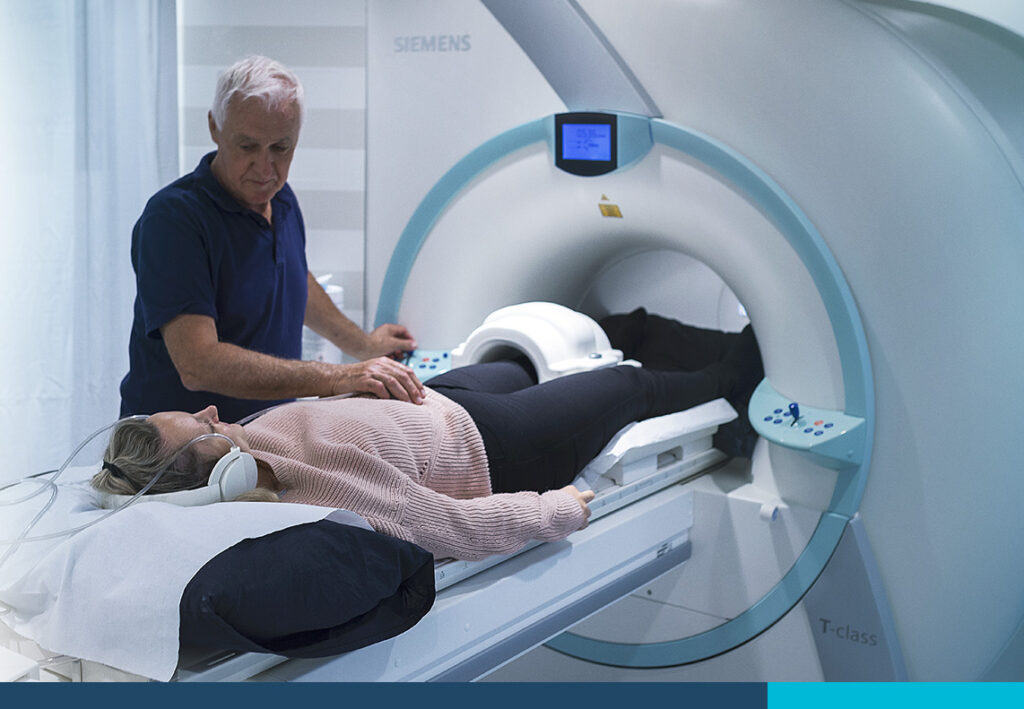
What is an MRI scan?
MRI stands for Magnetic Resonance Imaging. During the examination, the MRI scanner uses a powerful magnetic field and radio waves to create detailed images of the body’s organs and tissues.
An MRI scan is particularly well suited for examining the body’s soft tissues. This can include the brain, spinal cord, muscles, tendons, cartilage and ligaments.
The images are subsequently assessed and described by a consultant radiologist.
What can an MRI scan be used for?
An MRI scan can be used to examine many different parts of the body.
At CPH Privathospital we offer MRI scans of, among other things:
- The brain
- The spine and spinal cord
- Shoulders, elbows and wrists
- Hips, knees and ankles
- Muscles, tendons, cartilage and other soft tissues
- The bile ducts
An MRI scan can be used, among other things, in cases of suspected injuries or diseases of the back, musculoskeletal system, brain and the body’s soft tissues.
It is your doctor and our specialists who assess which examination is relevant for you.
How is an MRI scan performed?
Before the examination, one of our radiographers will inform you and go through the procedure with you.
During the scan, you lie on a table that is slowly moved into the MRI scanner. The part of the body to be examined is positioned in the centre of the scanner.
We will help you lie comfortably. It is important that you lie still during the examination so that the images are as clear as possible.
The MRI scanner produces a series of loud knocking and humming sounds while the images are being taken. You will be given hearing protection, and the radiographer can see and communicate with you throughout the examination.
You will also have the opportunity to contact the radiographer if you need help during the procedure.
An MRI scan typically takes between 15 and 45 minutes. The examination consists of several shorter image series.
Preparation before the examination
Before the examination, you will receive information on how to prepare for your specific examination.
As a rule, you can eat, drink and take your usual medication as normal, unless otherwise stated in your appointment letter or you have received other instructions from your doctor.
As the MRI scanner uses a powerful magnetic field, metal objects and electronic equipment must not be brought into the examination room.
Before the examination, you must therefore remove, among other things:
- Jewellery and watch
- Mobile phone and other electronic devices
- Keys, coins and payment cards
- Hearing aid
- Clothing with metal parts
- Removable piercings
We recommend that you arrive in comfortable clothing without zips, metal buttons or other metal parts.
Metal and implants in the body
It is important that you tell us if you have metal or electronic implants in your body.
This includes, among other things:
- Pacemaker or other electronic equipment
- Cochlear implant
- Artificial joints, screws, plates or clips
- Vascular clips or stents
- Medication pump
- Metal foreign bodies, particularly in or around the eyes
An implant does not necessarily mean that you cannot have an MRI scan. It depends on the type and material of the implant.
We therefore need the necessary information about the implant so that our specialists can assess whether the examination can be performed safely. Please contact us before your appointment if you are in doubt.
MRI scan with contrast agent
For some MRI scans, a contrast agent is used to make certain organs, blood vessels or tissues clearer in the images.
The contrast agent is normally administered through a thin needle in a vein in the arm. You will feel a small prick when the needle is inserted.
If your examination requires contrast agent, we may need information about your kidney function.
It is important that you tell us if you have previously reacted to contrast agent, have reduced kidney function or have other diseases that may be relevant to the examination.
You will receive more detailed information before the examination if contrast agent is to be used.
If you have claustrophobia
It is completely natural to feel uneasy about lying in an MRI scanner.
Please tell us in advance if you have claustrophobia or have previously had difficulty completing an MRI scan. We can then talk to you about the examination and help you prepare as well as possible.
The radiographer is in contact with you throughout the examination, and you can let us know at any time if you need a break.
If you need sedative medication, this must be arranged with your doctor before the examination. You must not drive a car afterwards if you have received sedative medication.
Can everyone have an MRI scan?
The vast majority of people can have an MRI scan. However, there may be circumstances that require special assessment or adaptation of the examination.
Always tell us before the examination:
- If you are or may be pregnant
- If you have metal or electronic implants in your body
- If you have previously had metal in your eyes
- If you have difficulty lying flat and still
- If you have claustrophobia
- If you have previously reacted to contrast agent
- If you have reduced kidney function
Contact us before your appointment if you are in doubt about whether something may be relevant to the examination.
Do you not have a referral for an MRI scan
You must have a referral to have an MRI scan.
If you do not already have a referral from your own doctor or consultant, CPH Privathospital offers a complete pathway that includes both medical assessment and referral.
During a brief medical consultation, the doctor will review your symptoms and medical history and assess which MRI scan is relevant for you.
What you get:
- A brief medical consultation and assessment of your symptoms
- Medical referral for the relevant MRI scan
- MRI scan of one region
- Telephone consultation with a doctor about the result
- Guidance on any further investigation or treatment
Price
Total price: 3,500 kr.
Why is a medical assessment included?
It is important that the correct type of MRI scan is ordered based on your symptoms and medical history. An MRI scan can also reveal changes that require a medical assessment.
By combining medical consultation, referral, scanning and follow-up, you receive both the relevant examination and a medical review of the result.
When will you receive the result?
After the examination, the images are assessed and reported by a consultant (specialist doctor) in radiology.
If you have been referred by your own doctor or another clinician, the result will be sent to the person who referred you. It is the referring doctor or clinician who will review the result with you and discuss the further course with you.
If you have booked our complete pathway, a doctor will review the result with you by telephone and advise you on any further investigation or treatment.
Price of MRI scan
The price depends on which area is to be examined and whether contrast medium is required. See our current prices for MRI scans.
Contact and appointment booking
If you have questions about the examination or wish to book an appointment, please feel free to contact CPH Privathospital.